Corporate Email Security Solutions & Domain Scan
In today's fast-moving business world, electronic mail acts as the foundational baseline for administrative decision-making, vendor invoice routing, customer engagement, and high-level donor stewardship. Whether you lead a growing retail team or coordinate front-line community outreach for an Ontario non-profit organization, your public email domain serves as the digital identity of your brand.
Unfortunately, because it is open and globally facing, electronic messaging is also the single most targeted exploit vector for contemporary cybercriminals.
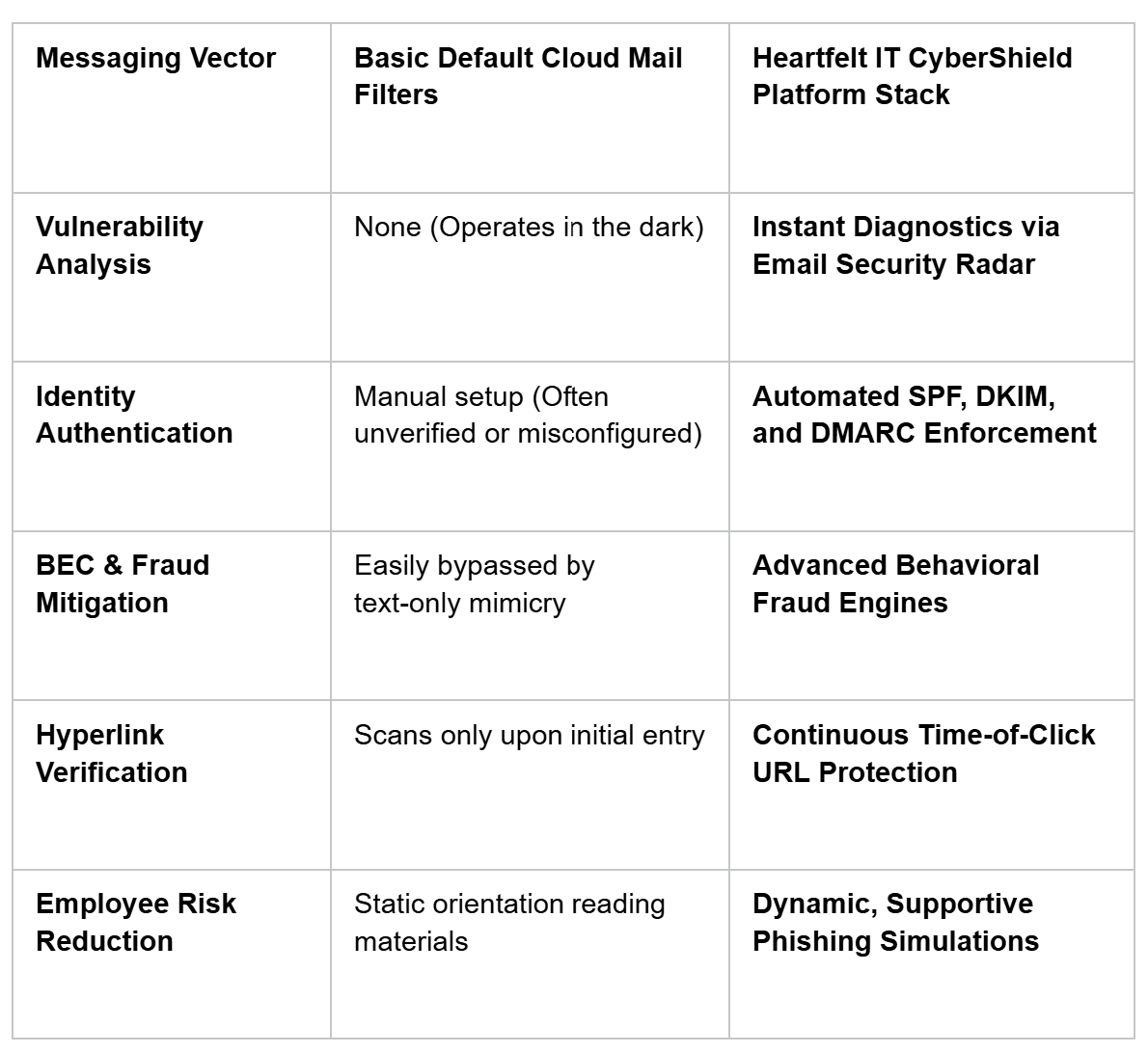
Many executive leadership teams rely passively on the default protection settings included in their basic cloud infrastructure licenses. However, generic spam filters are built primarily for processing speed and message delivery—leaving vast security loopholes open to targeted social engineering schemes, fileless malware payloads, and executive domain impersonation.
At Heartfelt IT, we remove the technical stress from data defense. We equip small businesses and nonprofits with enterprise-grade corporate email security solutions, starting with immediate domain analysis through our specialized diagnostic tool and permanent shielding via our comprehensive defensive platform.
The Strategic Necessity of a Domain Scan: Testing for Silent Loopholes
Modern cyber threat actors rarely deploy crude, easily detectable spam messages. Instead, they execute highly calculated, text-based operations engineered to slip straight past simple inbound filters unnoticed.
The Attack on Identity: Business Email Compromise (BEC)
The most financially destructive threat facing organizations today is Business Email Compromise (BEC). In a typical BEC exploit, an attacker does not attach a virus file. Instead, they register a look-alike domain that differs from your actual name by a single letter, or they hijack an unverified external connection.
By impersonating an executive or a major partner, they issue an urgent text requesting an emergency vendor invoice redirect, an unauthorized wire transfer, or a dump of employee files. Because the email contains no malicious code blocks, standard endpoint antivirus tools remain completely blind to the threat.
The Risk of Domain Spoofing
If your underlying domain management lacks verified, automated cryptographic authentication, external bad actors can effortlessly send fraudulent emails that display your literal brand address in the "From" line. They can target your clients, exploit your donors, and deceive your employees.
To determine if your domain is currently exposed to these precise exploitation loops, it is vital to audit your identity pathways instantly using our live diagnostic checkpoint: Heartfelt IT Email Security Radar. This immediate scan evaluates your system's public vulnerabilities and highlights exactly where malicious actors could exploit your brand identity.
Total Perimeter Defense: Implementing the Heartfelt IT CyberShield
Once you have identified your structural vulnerabilities through our radar check, your organization must transition from temporary analysis to permanent protection. We achieve this absolute security posture by deploying the Heartfelt IT CyberShield—an elite, multi-layered managed cybersecurity ecosystem built specifically to safeguard lean, purpose-driven teams.
[Email Security Scan Radar] ➔ [Identify Authentication Gaps] ➔ [Deploy Heartfelt IT CyberShield] ➔ [Total Domain & Messaging Safety]
When integrated into your architecture, the CyberShield platform delivers continuous protection across four essential technical pillars:
1. Advanced Inbound & Outbound Secure Email Gateway (SEG)
Our platform scans all incoming data packets in real time using advanced behavioral analysis and threat intelligence streams. We evaluate structural intent, unpack attachments inside isolated cloud sandboxes, and scrub out zero-day exploits. Simultaneously, outbound channels are monitored continuously to prevent data loss or accidental leaks of proprietary corporate files.
2. Automated Cryptographic Authentication Management
To render your domain completely bulletproof against spoofing campaigns, our systems engineers configure and maintain the three structural identity layers of modern messaging:
📧 SPF (Sender Policy Framework): A public DNS registry file confirming exactly which global mail servers have legal authorization to send messages using your name.
🔑 DKIM (DomainKeys Identified Mail): Attaches an unforgeable, unique cryptographic digital signature to every outbound message, guaranteeing that data remains untampered with in transit.
🛡️ DMARC (Domain-based Message Authentication, Reporting, and Conformance): The ultimate policy control layer. DMARC tells receiving servers around the world exactly what to do if an unauthorized email attempts to mimic your name—instructing them to instantly quarantine or reject the fraudulent message.
3. Controlled Phishing Simulations and Awareness Modules
Technology alone cannot catch every human error; awareness forms your ultimate perimeter line. We coordinate internal, low-risk phishing simulation campaigns modeled directly after modern hacker techniques. This gives your small business or non-profit staff practical experience spotting urgent messaging traps, turning your personnel from an security vulnerability into an active human firewall.
4. Real-Time Link Sandboxing and Time-of-Click Rewriting
Hackers often insert completely benign hyperlinks into emails to clear initial inbox filters, later redirecting those addresses to malicious credential-harvesting pages after delivery. Our system utilizes time-of-click URL rewriting. Every time an employee clicks an embedded link inside a message, our security layer instantly evaluates the destination web space before letting the browser connect, stopping data theft instantly.
The Strategic Impact of Monitored Email Stewardship
Frequently Asked Questions
How does the Email Security Scan Radar work?
Our diagnostic radar check parses publicly accessible domain registry records over the web. It reads your active SPF, DKIM, and DMARC records to determine if your domain configuration can be easily spoofed or hijacked by unauthorized external mail systems. It does not access, read, or alter your internal private email contents.
Is the CyberShield platform complicated to deploy for a non-profit or small office?
Not at all. We handle the entire engineering setup, configuration routing, and backend monitoring. The deployment process requires zero downtime or workflow interruptions for your operational staff, allowing you to stay focused on running your business or serving your community.
What is the difference between basic spam blockers and the CyberShield gateway?
Standard filters only check for generic, pre-recorded spam keywords and known blocklists. The CyberShield platform evaluates the contextual intent of language, monitors active domain routing patterns, sandboxes dangerous code, and actively protects users at the exact moment they click a link.
Interested to learn more about Email Security? Get your email security score and know if you’re an easy target by clicking here: https://heartfeltit.email.security/radar